
KJCC Release Destinations
Kansas Juvenile Correctional Complex belongs to Kansas Department of Corrections Juvenile Services. Its Topeka location does not make it part of Shawnee County’s jail system. A juvenile leaving KJCC may return to a guardian, enter an approved placement, transfer to another juvenile agency, or continue under state juvenile supervision. The placement or supervision record may be restricted from the public.
A facility departure ends one placement, but it does not always end state authority. Transfer and supervised return are distinct from full discharge. The responsible juvenile agency and controlling court order define the event. Public adult tools cannot safely fill that gap.
Confirm KJCC Release Lawfully
KASPER is the Kansas Adult Supervised Population Electronic Repository. It must not be generalized into a juvenile release search. Kansas VINE is an adult county-jail service and also is not the KJCC route. The official path depends on authorization and the particular juvenile case.
- Identify your lawful role, such as guardian, attorney, court participant, or authorized agency representative.
- Use the official juvenile agency contact tied to the case and provide only the identifiers requested.
- Ask the attorney or court professional for the current order, release conditions, and approved destination.
- Confirm whether the event was guardian return, placement, transfer, supervised release, or discharge.
- Respect any limit on redisclosure of the juvenile’s record or location.
The Shawnee County custody overview helps distinguish facilities, but its adult search routes do not unlock juvenile information. Someone without legal access should not expect state staff to confirm a named child’s custody or location.
KJCC Authorized Contact Route
The research identifies the official KJCC address but does not supply a verified facility telephone. No number should be invented. An authorized inquiry should proceed through KDOC Juvenile Services, the juvenile’s attorney, or the court handling the matter. The agency can determine whether the requester may receive a release or placement record.
Kansas Juvenile Correctional Complex1430 NW 25th Street
Topeka, KS 66618
KDOC Juvenile Services
KDOC’s central office is at 714 SW Jackson Street, Suite 300, Topeka, KS 66603, telephone 785-296-3317. That public contact does not make juvenile records open. Staff must apply the law, court rules, and the requester’s status before disclosing case-specific facts.
KJCC State Facility Identity
KJCC is distinct from two nearby systems. The Shawnee County Juvenile Detention Center is a short-term county facility. Topeka Correctional Facility is a KDOC adult state prison. KJCC is the state juvenile correctional complex. Each has different records, authority, and release verification.
| Facility | Type | Correct route |
|---|---|---|
| KJCC | State juvenile correctional | Authorized juvenile agency and court |
| County JDC | County juvenile detention | Authorized county facility and court |
| TCF | Adult state prison | KASPER and KDOC records |
| Adult Detention Center | Adult county jail | County booking and commitment records |
This system map prevents a serious error. An adult KASPER no-result says nothing reliable about a KJCC juvenile. A county roster no-result is equally irrelevant. The absence of an open juvenile lookup reflects the restricted framework.
KJCC Record Access Limits
Kansas public court access excludes many juvenile and child-in-need-of-care records. Registration-relief and related law also illustrates that juvenile and sensitive records can be governed by specific statutory limits. The successful manifest image comes from the official Kansas statute source assigned to KJCC.
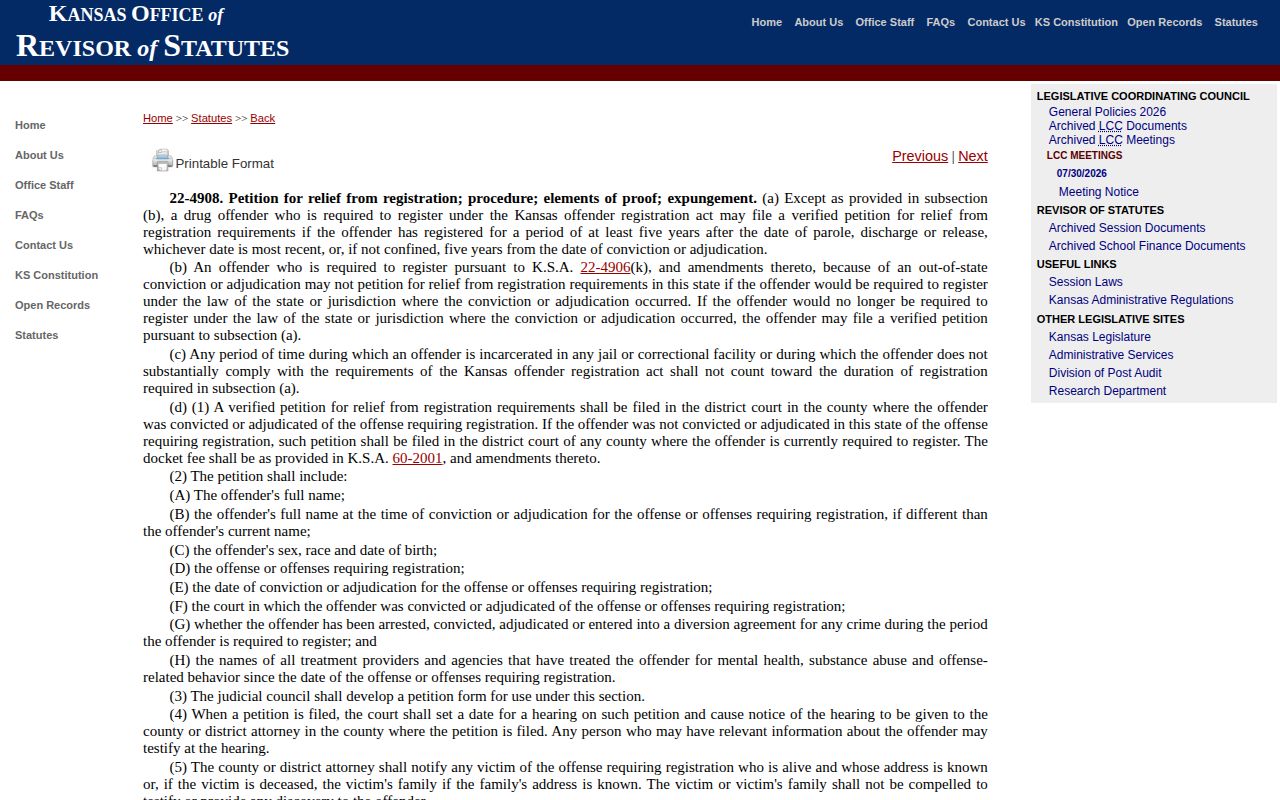
The image does not create a public juvenile locator. It supports careful statutory handling and the rule that an authorized source must decide access. A lawful restriction should not be treated as missing data.
When a guardian or attorney seeks a record, the request should be exact. Identify the juvenile case and the specific existing order or agency record needed. Avoid asking for a new public report or a broad list of releases. Narrow scope helps the agency assess authority and protect unrelated information.
Interpret KJCC Release Status
A guardian return means the agency or court approved a handoff. Placement means the juvenile was directed to another approved setting. Transfer means another juvenile authority or facility assumed responsibility. Supervised release means institutional placement ended while legal oversight continued. Discharge means the obligation identified by the controlling juvenile record ended.
- Placement
- An approved setting selected under juvenile authority.
- Transfer
- A move between custodians or facilities, not an unrestricted community release.
- Supervision
- Continued legal oversight outside the institution.
- Discharge
- The end of the duty or status named in the controlling record.
These terms should not be guessed from where a young person is seen. A juvenile can live outside the complex and still remain under placement rules or supervision. The current order and agency record are the reliable sources for an authorized person.
Note: Public silence about a juvenile protects privacy and cannot establish that custody, placement, or supervision ended.
Reconcile KJCC Release Records
The state juvenile agency record and court order answer related questions. The facility or agency record documents the physical change in placement. The court order supplies legal authority and may set conditions. A guardian or attorney should compare both when the exact event matters.
If one source says transfer and another appears to say release, ask the responsible agency to explain which placement ended and which authority continued. Do not publish or share a destination beyond the access granted. Safety and confidentiality remain part of accurate juvenile record handling.
KJCC research supports no public roster, no open release feed, and no adult-style historical search. The accurate outcome is a clear boundary, not a workaround. Official juvenile and court channels remain the only responsible route for a named person.
KJCC State Juvenile Route
Kansas Juvenile Correctional Complex is operated through KDOC Juvenile Services, but that agency relationship does not make the adult KASPER repository the normal search route. KASPER is documented for adults sentenced to the Secretary of Corrections, including adults in prison, on post-incarceration supervision, and discharged. KJCC records require the state juvenile channel and the access rules attached to the specific juvenile case.
An authorized guardian or attorney can begin by identifying the controlling court matter and the responsible Juvenile Services contact. The request should name a specific existing record, such as the order authorizing a placement change or the agency record documenting the end of institutional placement. It should not demand a newly created public release list. Staff may need to verify identity, legal relationship, and authority before discussing any named juvenile.
KDOC central contact information can route a request, but central-office contact does not guarantee disclosure. A juvenile record can contain sensitive placement and safety information. The agency may provide a limited response, direct the requester to the court, or withhold material that is not open. Each response must be understood within the juvenile framework rather than measured against the broader public fields available for an adult offender.
Follow KJCC Placement Changes
A KJCC departure is best understood as part of a placement chain. The prior record identifies KJCC as the state juvenile facility. The next order or agency entry identifies whether the juvenile returned to a guardian, moved to an approved setting, transferred to another authority, or began a supervised phase outside the complex. Full discharge is a separate conclusion and should appear in the controlling juvenile record before anyone describes state authority as ended.
Location alone cannot establish status. A young person living outside KJCC may still be under a placement plan or supervision. Conversely, a court may authorize a change that has not yet been carried out physically. The authorized reader should compare the effective date of the order with the agency’s actual movement record. That comparison separates a planned change from a completed one without exposing the destination publicly.
The county JDC cannot certify a KJCC release. Shawnee County adult corrections records cannot do so either. Topeka Correctional Facility contacts serve an adult prison and are also the wrong route. The fact that all these facilities are in Shawnee County creates geographic closeness, not shared custody files or public access rules.
When a record is unavailable to the public, do not substitute social posts, commercial databases, or an adult no-result. The official restriction is itself the controlling fact for public access. A person with lawful authority should continue through counsel, the court, or Juvenile Services.