
Annex Discharge Destinations
The Shawnee County Corrections Annex is part of the county correctional system, not a separate state prison. It houses screened trusties and sentenced work-release or reentry participants. A final release can return a participant to the community when county custody ends. Other movements can send the person back to the secure Adult Detention Center or place the person with another authority. The same county booking and commitment system records the final event.
Work release is a custody arrangement. It permits an approved person to leave for work under program rules while still residing in the correctional program. The person has not been discharged merely because they can be seen at work or elsewhere in Topeka. A trustee assignment likewise does not end the jail term. The key fact is whether the county recorded a discharge, transfer, or continued custody.
| Observed event | What it means | Best check |
|---|---|---|
| Leaves for approved work | Still in county custody | Program and commitment record |
| Returns to secure jail | Custody continues at another county site | County corrections record |
| Final discharge | Annex custody episode ends | Jail calendar or commitment entry |
| Transfer | Another authority takes custody | Destination in county record |
Confirm Annex Final Discharge
The public Shawnee County portal is a current-custody search that updates hourly. It may help identify a booking record, but a no-result does not prove why someone left the Annex. The daily booking report includes a release-date field for people in that report’s booking cohort. It is not a release-only list, so an older booking may require the archive or a formal record request. The broader Shawnee County released-inmate search explains how these sources fit together.
- Confirm the full name, birth date, booking number, and case number. These identifiers reduce same-name errors.
- Search the current county portal. Treat no match as a reason to check another source, not as proof of discharge.
- Review the daily booking report and archive for the booking cohort. Look for a populated Release Date tied to the correct person.
- Check the court case for the sentence, work-release authorization, later order, revocation, or discharge event.
- Ask county corrections or the County Clerk for the existing commitment record when the public display does not answer the question.
Kansas VINE may reflect an adult county-jail status change, but a status alert still needs context. A move from the Annex to the Adult Detention Center is not a release to the community. Likewise, a transfer to KDOC requires a KASPER follow-up. Always use the receiving system named in the county record.
Note: A participant’s approved time outside the Annex is not proof that a county sentence or custody term has ended.
Annex Records And Contact
Contact the Shawnee County Department of Corrections for facility information. For a formal county record, the County Clerk’s Kansas Open Records Act route can direct a request to the proper custodian. A precise request should name one person, one booking episode, and a short date range. Ask for the existing record showing discharge date, time, authority, and destination if recorded. KORA does not require the county to create a new report or answer an open-ended question.
Shawnee County Corrections Annex818 SE Adams
Topeka, KS 66607
785-251-5000
Fax: 785-251-4930
The county KORA form is handled through the Shawnee County Clerk at 200 SE 7th Street, Room 107, Topeka, KS 66603-3971. The listed telephone is 785-251-4155, and office hours are Monday through Friday, 8 a.m. to 4:30 p.m. Kansas law calls for action by the end of the third business day. A response can supply the record, state why more time is required, or give the legal basis for denial.
Annex Custody Program Facts
The county lists a capacity of 200 for the Shawnee County Corrections Annex. Capacity does not state how many people are currently assigned or how many will be released on a given day. It instead helps distinguish the Annex as a substantial county program site. The official program description identifies Trusty, Work Release, and a three-phase Re-Entry Program for sentenced Adult Detention Center inmates recommended through the court or program process.
The three program labels do not describe three types of release. They describe custody and reentry arrangements. A person can progress through a program while the underlying sentence remains active. Court orders, county program decisions, and the commitment record must be read together to determine whether the person remains confined, has moved to another county site, or has reached final discharge.
Annex Work Release Status
The official Inmate Work Program page is the best public source for the Annex’s distinct role. It shows that community movement can be part of custody. This fact guards against a common false conclusion: seeing someone outside the facility does not establish a release record.
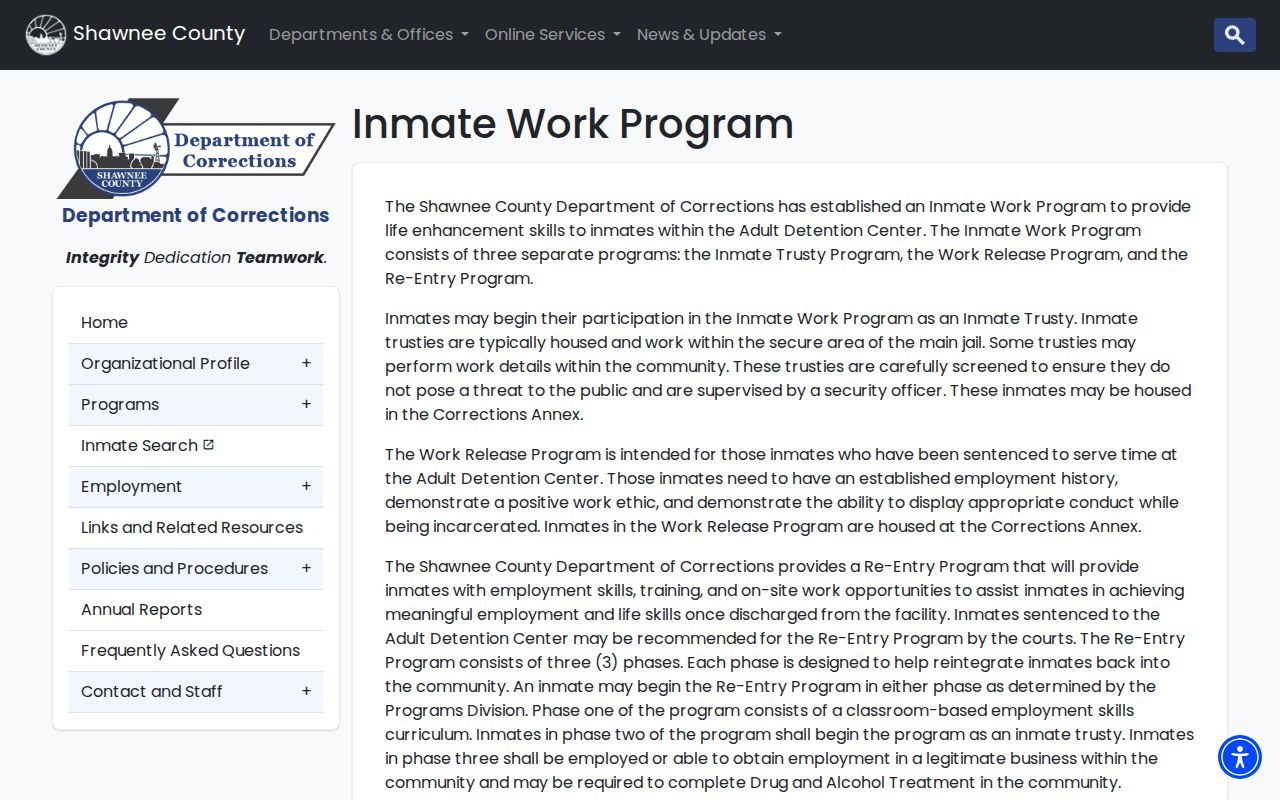
The image connects the Annex directly to work and reentry operations. It should be read with the county corrections record because the program page describes eligibility and structure, not the final discharge of a named person.
A court case may show the sentence or permission that led to work release. The jail record tracks the custody event. If a person violates program rules or receives a new court order, the next step may be a return to secure detention rather than community discharge. A later outside appearance still cannot settle that issue without the controlling records.
Annex Release Record Fields
The permanent jail or commitment record is more useful than a short web display because the state retention schedule marks it permanent or archival. It can include the cause and authority for commitment, identity details, property and money at commitment and release, booking and case information, bond data, and the discharge date, time, and authority. Those fields allow a reader to test whether an Annex movement was a final release.
- Trusty
- A screened person assigned work or responsibilities while remaining in custody.
- Work release
- Approved work in the community with continued residence in a correctional program.
- Reentry
- A structured transition process that can begin before final discharge.
- Discharge
- The documented end of the custody or legal obligation identified by the record.
Read the release authority with the court case. A release date alone establishes timing, not the full legal reason. If the record shows return to the Adult Detention Center, custody continued. If it shows transfer to KDOC, use KASPER to follow state movements and eventual supervision or discharge. If it shows community discharge, the county record establishes the end of that Annex custody episode.
Note: The permanent record is the durable source when the current roster and short daily-report archive no longer show the booking episode.
Annex Corrections Agency Route
Shawnee County’s jail system is run by the Department of Corrections, not by the sheriff. The Annex belongs to that system. Accurate agency naming speeds contact and reduces the chance that a request will be sent to the wrong office. The county department profile also describes the operating divisions and leadership behind the detention and reentry work.
The department profile provides that organization context. A successful manifest image captures the county corrections divisions and leadership source used for this facility.
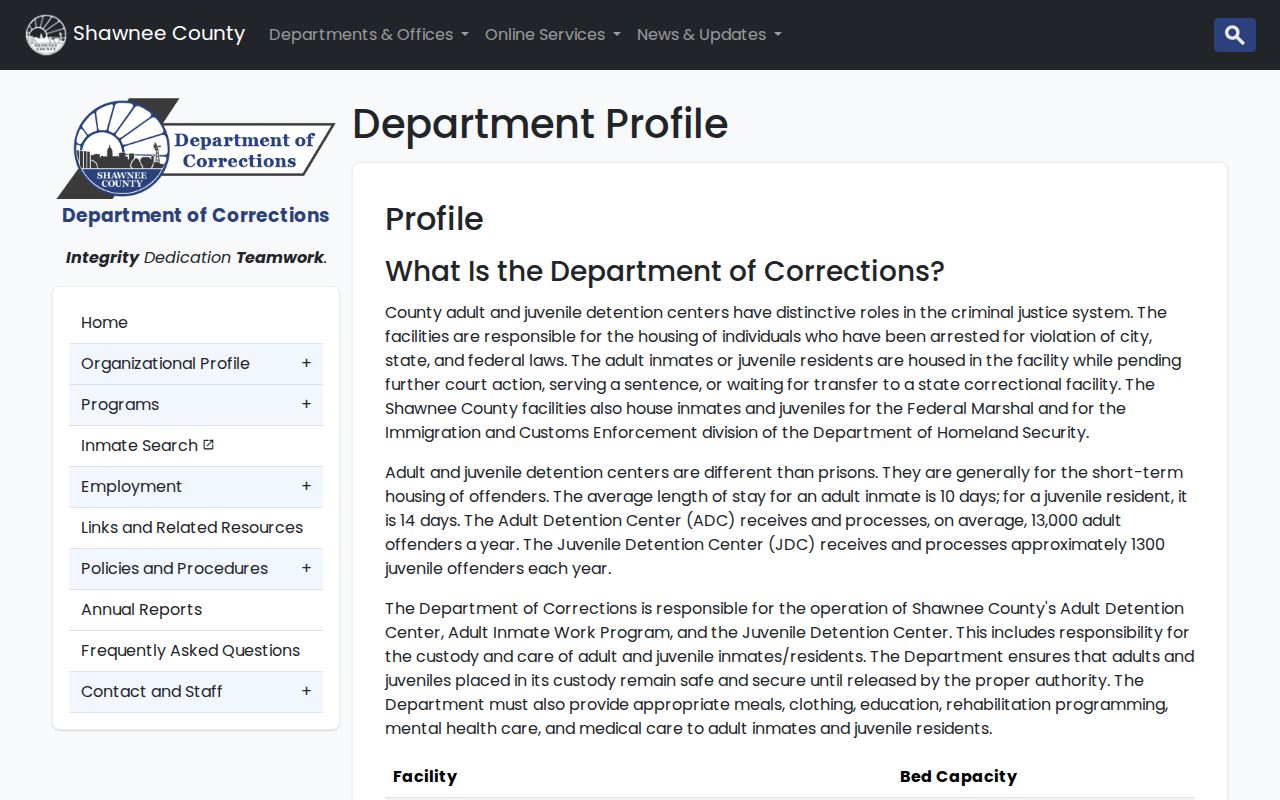
The agency view supports a practical route: use county corrections for the Annex and its programs, the County Clerk for a formal KORA channel, and Shawnee District Court for the legal case. Those sources should be reconciled rather than substituted for one another.
Verify Annex Custody Movements
An Annex movement can look like release when viewed without the county record. A work-release participant may travel to an approved workplace and return to the Annex. A trustee may perform assigned duties outside a housing area while remaining confined. A person may also move from the Annex back to the secure Adult Detention Center. None of those events is final discharge. The county commitment record should identify whether custody continued and where responsibility moved.
The court file adds legal context. It can show the sentence, authorization for a structured program, later revocation, or another order affecting placement. Yet a court order and physical movement are not the same fact. The order states legal authority, while the corrections record documents what the county carried out. Compare the case number and effective date across both sources. If a daily booking report contains a Release Date, confirm that the row belongs to the correct booking episode and ask whether the destination was the community or another custodian.
KASPER becomes relevant only when the county record shows transfer into Kansas state custody. It should not be searched as though every Annex participant were a KDOC prisoner. Kansas VINE may report an adult county-jail status change, but the alert does not by itself distinguish discharge from transfer or movement within the county system. Follow the receiving system named in the formal record.
A precise KORA request can ask for the existing discharge or movement entry, including date, time, authority, and destination if recorded. The requester should provide the full name, birth date, booking number, case number, and narrow date range. That scope helps the custodian locate the correct episode without being asked to create a new custom release report.
Note: Community work access is a program privilege within custody, while discharge is the recorded end of the county custody episode.