
Shawnee Probation and Parole Types
Release from a building and release from a sentence are separate events. Kansas parole generally applies to an indeterminate prison sentence. The Kansas Prisoner Review Board decides whether an eligible person is suitable for release. Postrelease supervision follows the prison part of most determinate guideline sentences. Probation is a community sentence imposed by a court and may be administered by court services or community corrections. Someone may leave the Shawnee County jail on bond, after time served, or after a dismissal without entering any of these programs.
| Type | Who orders or manages it | Best public check |
|---|---|---|
| Parole | Prisoner Review Board and KDOC Parole Services | KASPER status, movements, and parole office |
| Postrelease supervision | Required after many determinate prison terms | KASPER supervision type and sentence dates |
| Probation | District court; court services or community corrections may supervise | Court case plus the current supervising agency |
The distinction affects what a result means. A parole-office location usually shows that prison custody ended while legal supervision continues. A probation order may exist even when KASPER has no current entry. Conversely, a county-jail release record documents the end of that custody event but does not by itself identify a later supervision term.
- Discharge
- The end of the sentence obligation or supervision authority shown in the controlling record.
- Revocation
- An order returning a supervised person to custody after a violation process.
- Absconder
- A person whom the supervising agency reports has stopped reporting or cannot be located.
Check Shawnee Post-Release Supervision
KASPER, the Kansas Adult Supervised Population Electronic Repository, is the public starting point for KDOC parole and postrelease records. It covers people sentenced to the Secretary of Corrections since 1980, including many who are supervised or discharged. It is not a complete list of all Shawnee County probation cases or people released directly from the county jail.
- Accept the KASPER disclaimer and search by KDOC number when known. Otherwise use a full name, birth date, and other identifying fields.
- Match the KDOC number, photograph, birth date, conviction county, case, and physical description. A name alone can identify the wrong person.
- Read Supervision Type, Parole Supervision County, office, movements, and sentence dates together. Follow the timeline rather than relying on one label.
- If the case is probation, inspect the Kansas district-court case and confirm current status with the named local agency. KASPER may be incomplete for newer community-corrections events.
- Use the supervising office only to confirm public routing. Reporting instructions and private case details may not be disclosed.
KDOC warns that modernization prevents KASPER from showing some community-corrections probation events after April 21, 2021. That is a material gap, not proof that probation ended. Current Shawnee probation should be checked against the court docket and supervising local agency. KASPER and its absconder lists update each working day, so weekend or same-day changes can appear later.
The KASPER advanced form supplies several useful ways to narrow a Shawnee County supervision check. Its labels include Last Name, First Name, Middle Name, Search Alias, KDOC Number, State ID Number, Birth Date, Conviction County, Supervision Type, Parole Supervision County, and Community Corrections Supervision Location. Select Shawnee only when the record supports that connection. Conviction county, supervision county, office, and residence describe different facts.
The KASPER search screen shows how the state combines identity and supervision filters. Check the official form before choosing fields.
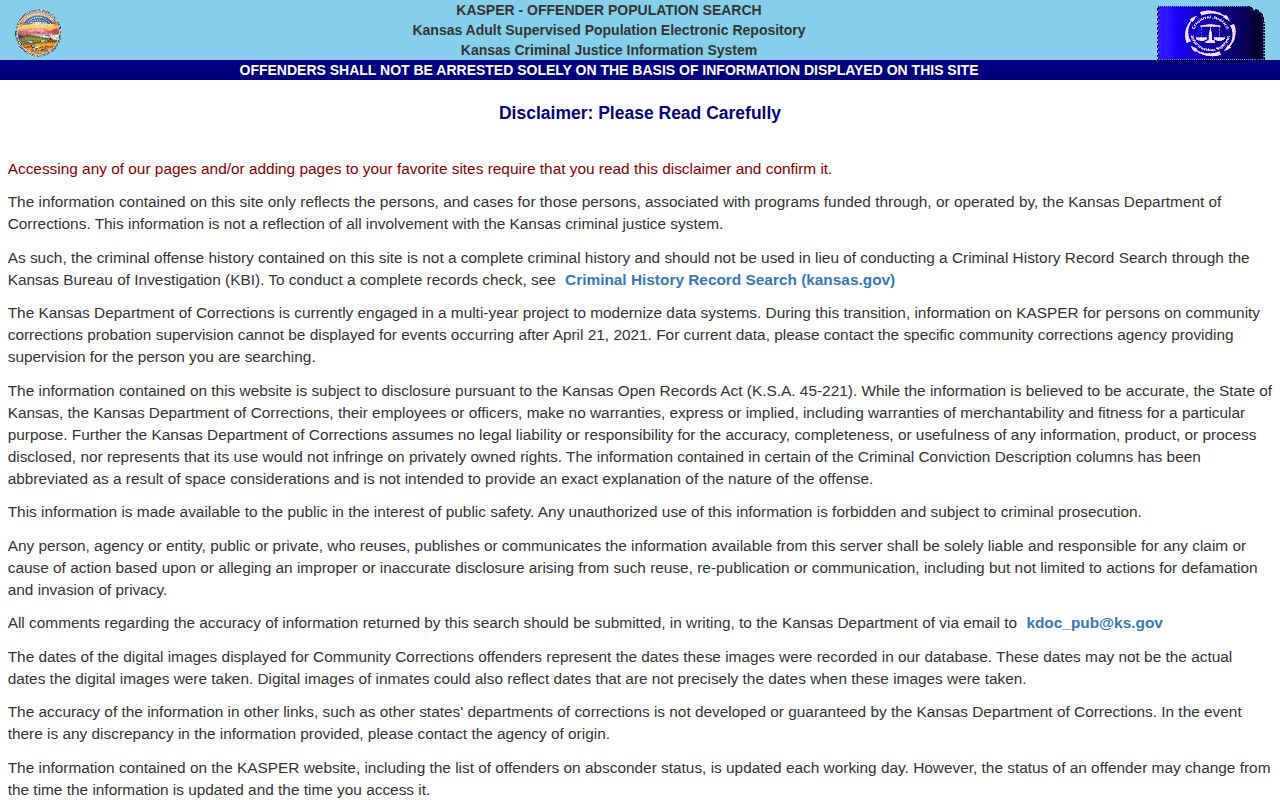
A matched record should be read from identity through movement history. The search form is only the entry point; a parole office or supervision type on the person record provides the Shawnee County post-release fact.
Shawnee Parole Office Routing
The KDOC parole-office directory lists the Topeka Parole Office for a five-county northern region. A KASPER office association can route a status question, but it does not prove that the person lives in Shawnee County. The region also serves Pottawatomie, Jackson, Osage, and Wabaunsee counties.
2029 SW Western Avenue
Topeka, KS 66604
785-296-5515
KDOC also publishes an automated reporting number for people under supervision. That line is not a public person-search service. For a public verification, use the KASPER record and the office contact that appears there. Do not infer a home address, daily schedule, or reporting site from a regional office listing.
When a KASPER result names another parole office, use that office rather than routing the question through Topeka. A change in office can reflect an approved transfer of supervision. It need not mean a new conviction or new release. The public record may show enough to identify the office, while case-specific conditions and personal reporting details remain outside ordinary public verification.
Shawnee Supervision Status Changes
Supervision records change after discharge, revocation, transfer of office, or a reported failure to report. KASPER maintains separate public pages for parole absconders and community-corrections absconders. Keeping those categories separate prevents a parole record from being mistaken for a court-probation case.
An absconder entry does not prove present incarceration. Its disappearance does not prove sentence discharge. KDOC says status can change and warns that no one should be arrested solely from the display. Confirm a current public status through the supervising agency or court. VINELink serves county-jail custody notifications, not supervision compliance, so it cannot replace those checks.
A revocation is also different from an absconder label. Revocation follows a legal or administrative process that can return a person to custody. KASPER movements may later show that return, while a court docket may document a probation revocation. Read dates in order. A person can appear in the community, be reported missing from supervision, and later return to custody without any one screen explaining the full sequence.
How Shawnee Supervision Ends
Physical release may begin supervision rather than end the sentence. A determinate Kansas sentence commonly moves from prison to a stated postrelease term. An indeterminate sentence may move to parole or conditional release. Revocation can return the person to custody. The KDOC terminology glossary helps distinguish those stages.
Discharge is supported by the actual KASPER status, movement history, sentence dates, and any Board or court order. An indeterminate person may receive early discharge from the Board or reach maximum sentence expiration. A determinate person may receive applicable credit while on postrelease supervision. For probation, use the court docket for a discharge order and check the supervising agency when the docket is not current. The Shawnee County released-inmate search provides the separate county jail and court paths.
Parole eligibility is not discharge and does not guarantee release. The Prisoner Review Board public-comment schedule operates monthly. Research conducted in July 2026 showed a sequence in which public comment preceded the hearing month, and a possible-release month followed. Appearance on that list meant a hearing was approaching, not that parole had been granted.
The Board uses three decision terms that should remain distinct. Parole means the Board found the person suitable for release, subject to legal timing and conditions. A pass denies parole for a stated interval. A continue postpones a decision for more information, evaluation, deliberation, or votes. No official public person-by-person decision database was found. After a hearing, recheck KASPER or request the decision through KDOC records if the formal order is needed.
Shawnee Annex Work Release
The Shawnee County Corrections Annex supports Trusty, Work Release, and a three-phase Re-Entry Program. A participant may be outside the facility for approved activity while still residing in custody. Seeing that person in the community therefore does not establish discharge, parole, or probation.
Verify the custody stage through the county booking and commitment record. If the person later enters KDOC supervision, KASPER becomes relevant. County work release should not be relabeled as state postrelease supervision merely because both involve time in the community.
Property After Shawnee Release
The county corrections FAQ says authorized adult property may be mailed or packaged for pickup. An authorized person has 60 days after release to collect it before the county treats it as abandoned and destroys it. Transfer-related pickup occurs at the ADC or JDC lobby during regular hours and requires valid photo identification.
This property window is an administrative deadline. It does not establish the type of release or whether supervision remains. Use the release record and KASPER or court case for those questions.
Shawnee Parole Hearing Records
The Board’s upcoming-offender list includes commitment name, KDOC number, conviction county, case number, offense description or code, and facility grouping. Conviction county is not necessarily the person’s home or planned return county. A Shawnee entry therefore does not establish supervision by the Topeka office.
After the hearing window, compare KASPER status and movements. If the individual decision is needed, request the existing Board decision or order through KDOC KORA. Annual reports provide aggregate outcomes, not a substitute person-level result.