
Topeka Prison Release Paths
Topeka Correctional Facility is operated by the Kansas Department of Corrections. Its Shawnee County address does not make it a county jail. People there are in the state sentenced-offender system. A departure can lead to another KDOC prison, a work-release setting, parole, conditional release, mandatory postrelease supervision, custody under a detainer, or complete discharge from the sentence.
The public record must be read as a movement history. A prison location indicates institutional custody. A parole office or post-incarceration supervision status can show that the prison portion ended while legal supervision continues. A discharged record is stronger evidence that both KDOC custody and supervision ended. The exact result language controls, and an anticipated date should never be substituted for an actual movement.
| TCF event | Record meaning | Where to verify |
|---|---|---|
| Prison transfer | KDOC custody continues | KASPER movements |
| Parole or conditional release | Community release with supervision | KASPER and PRB record |
| Postrelease supervision | Prison term ended, supervision remains | KASPER and parole office |
| Sentence discharge | KDOC obligation ends | KASPER and discharge record |
Confirm Topeka Prison Release
KASPER, the Kansas Adult Supervised Population Electronic Repository, covers people sentenced to the Secretary of Corrections since 1980. It includes people in prison, on post-incarceration supervision, and discharged. That makes it the correct public release search for Topeka Correctional Facility. Kansas VINE is not the right system because the Attorney General describes it as an adult county-jail service that excludes KDOC prisoners.
- Accept the KASPER disclaimer and search by KDOC number when known. A number is safer than a name alone.
- Otherwise use the full name and add birth date, conviction county, case number, photo, or other identifiers.
- Open the record and read current location, custody or supervision level, parole office, and movement history together.
- Separate Anticipated release date from a completed release movement. The estimate can change.
- Request the sentence computation and release or discharge document from KDOC if the public record remains unclear.
The Shawnee County release search overview separates county and state custody paths. For TCF, do not use the county daily booking report, county roster, or county commitment record. Those sources belong to the Adult Detention Center and Annex. A TCF person should be traced through KDOC.
Note: KASPER is updated on working days, so a very recent movement may not appear at once.
Topeka Release Records Contact
Facility staff can confirm the correct operating agency and general contact route, but the formal public-record channel is KDOC. Ask for records that already exist. Useful items include the sentence-computation sheet, release movement and type, discharge certificate, Prisoner Review Board order, supervision start or discharge dates, and public location history. Include the KDOC number whenever possible.
Topeka Correctional Facility815 SE Rice Road
Topeka, KS 66607
785-296-3432
KDOC’s central office is at 714 SW Jackson Street, Suite 300, Topeka, KS 66603, telephone 785-296-3317. The department directs new corrections-record requests through its online KORA portal. A narrow request that identifies the person, KDOC number, and desired document is easier to process than a broad question about release.
Topeka State Prison Identity
The official Topeka Correctional Facility page confirms the KDOC facility identity and contact. This distinction prevents the most common routing error: searching a Shawnee County current-custody portal for a person who served a state sentence.

The image ties the release inquiry to the state facility. County corrections has no authority to create or certify a KDOC discharge record just because TCF is located in Topeka.
A state prison release also uses different terms. Parole applies to eligible people whose release is approved under the indeterminate-sentence process. Conditional release can arise from the sentence rules before maximum expiration. Postrelease supervision follows the prison portion of many determinate sentences. Discharge means the person’s obligation on that KDOC sentence has ended. These are related but not interchangeable events.
Topeka Offender Search Fields
KASPER offers basic and advanced fields. The documented labels include Show Photos, Display Thumbnail Photos, Last Name, First Name, Middle Name, Search Alias, KDOC Number, State ID Number, Race, Gender, Birth Date, Age Range, Conviction County, Supervision Type, Parole Supervision County, and Community Corrections Supervision Location. Shawnee County can appear as conviction or parole-supervision county, but that does not prove where the person lives after release.
| Field | Use | Limit |
|---|---|---|
| KDOC Number | Best unique search key | Must match exact record |
| Birth Date | Separates similar names | Confirm with more than one field |
| Movement History | Shows facility and release transitions | Read with current status |
| Parole Office | Shows supervision routing | Not proof of home address |
| Anticipated Release Date | Current sentence estimate | Not actual release |
KDOC warns that anticipated dates can change because of credit earnings or loss, amended sentences, consecutive terms, mandatory provisions, detainers, revocation, escape time, and corrections to the record. To confirm an event, compare status and movement history, then obtain the formal document if the date matters to a court or legal process.
Topeka Release Notification Boundary
Kansas VINE covers adult county jails and excludes KDOC prisons. It should not be offered as a TCF notification route. KDOC Victim Services operates a separate notification process for qualifying state custody and supervision events. This boundary is especially important in Topeka because the county jail and a state prison are in the same city.
Use the KDOC notification form for the state channel. Public KASPER searching and registered notification are different tools. KASPER lets a reader inspect a public record. Notification enrollment provides event alerts under the department’s process. Neither converts an anticipated date into a guarantee.
Read Topeka Release Dates
The KASPER sentence view may contain an Anticipated release date, parole eligibility, conditional release, and sentence expiration. Each answers a different question. Parole eligibility is the point at which a person may be considered under the applicable sentence law. Conditional release is a specific release mechanism. Sentence expiration marks the outer sentence calculation. The anticipated date is a working calculation affected by credits and later events.
- Anticipated date
- A projected date based on the current sentence calculation.
- Parole
- Conditional community release approved for an eligible person under continued supervision.
- Postrelease supervision
- A required supervised term after the prison portion of a determinate sentence.
- Discharge
- The end of custody and supervision on the identified KDOC sentence.
A detainer can change the practical destination even when the prison term ends. A detainer is authority or a request for another agency to take custody. Thus, the record may show a KDOC release movement without a return to the community. Ask for the movement destination or related public document when status has that ambiguity.
Note: A parole office in KASPER supports release to supervision, but the office location is not proof of where the person resides.
Topeka KDOC Record Requests
The successful manifest capture of the KDOC request portal shows the correct formal route for a TCF release or discharge document.
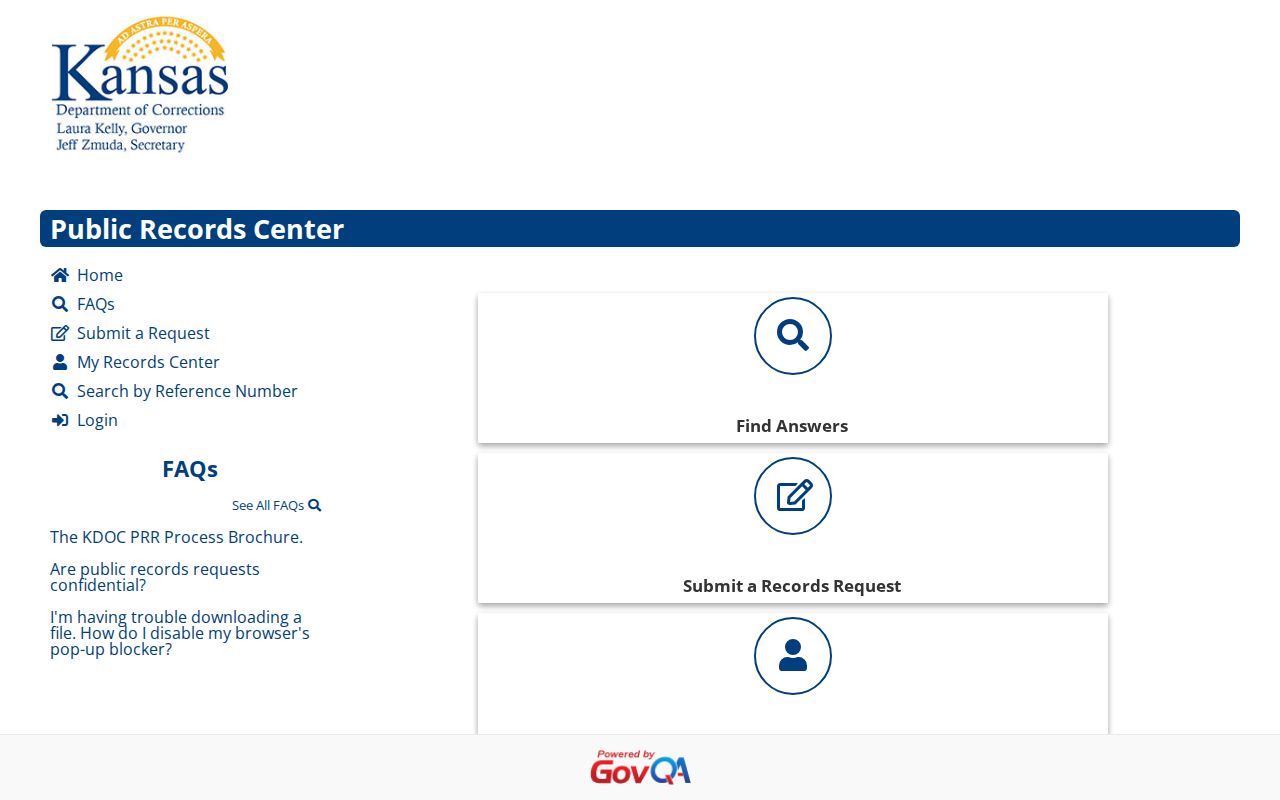
The portal supplements KASPER rather than replacing it. Search first to gather the KDOC number and exact terms. Then request the existing computation, movement, order, or discharge record needed to resolve the remaining question.
Trace Topeka Sentence Movements
A Topeka Correctional Facility departure should be traced through the state sentence record, not through Shawnee County booking data. KASPER movement history can show a change from TCF to another KDOC location, a supervision office, or a released status. The current location and custody or supervision level must be read with that history. A facility name disappearing from the current field does not by itself establish discharge from the KDOC sentence.
Release to parole, conditional release, and postrelease supervision all place the person outside the prison while legal oversight continues. Full discharge is different. It means the KDOC obligation identified in the record has ended. An indeterminate sentence can involve parole eligibility and a Prisoner Review Board decision. A determinate sentence normally includes a calculated prison portion followed by the postrelease term set by law and the sentence. Those paths should not be collapsed into one generic release date.
The Anticipated release date is a projection. KDOC notes that release calculations may change with earned or lost credit, sentence amendments, consecutive terms, mandatory provisions, detainers, revocation, escape time, or an administrative correction. Confirm the actual event through status and movement entries. When the precise legal date matters, request the sentence-computation sheet and release or discharge record through the KDOC KORA portal.
A detainer can redirect the person to another custodian when the prison portion ends. In that case, the TCF movement is real, but it is not a return to the community. The public record may identify a receiving authority or another location. If it does not, a narrow KDOC request should ask for the public movement type and destination information that exists. County VINE and the Shawnee jail roster cannot resolve this state-prison handoff.
Identity confirmation remains essential. Match the KDOC number, birth date, photograph, conviction county, case number, and physical details as available. A parole office can support a conclusion that the person left institutional custody for supervision, but it does not prove a Shawnee County residence. The office may serve several counties, and supervision location is not the same as a home address.
Note: A completed KDOC movement documents what occurred; an anticipated date only describes the calculation in effect when the record was updated.