
Adult Detention Release Paths
The Shawnee County Adult Detention Center is the county’s main short-term adult jail. It holds people awaiting court action, serving local sentences, or waiting for transfer. A person may leave after bond, recognizance, time served, dismissal, a judge’s order, or completion of a local term. The same physical departure may instead place the person with the Kansas Department of Corrections, the United States Marshals Service, Immigration and Customs Enforcement, another county, or another facility. “Released” must therefore be read as released from this jail, not always released to the community.
The strongest local source is the jail or commitment record. Kansas law requires the jail calendar to record the authority and time of release. The permanent county record can also hold the discharge date and authority, booking and case data, bond details, and property or money recorded at release. The daily booking report is faster to check and includes a Release Date field, but it groups people by booking date rather than by release date. Someone booked earlier may not appear on the current report even if released today.
Confirm Adult Detention Release
The official Shawnee County inmate portal searches current custody and updates hourly. A match shows that the person remained listed at that update. No match is only a prompt to move to release sources. It can reflect a recent release, transfer, spelling mismatch, processing delay, or custody in another system. The full Shawnee County released-inmate search path is also covered on the home page.
- Search the current portal with the last name, first name, and birth date. Save the booking number or case number if a match appears.
- Open the daily booking report and its archive. Match identifiers, then look for a populated Release Date in that booking row.
- Check Kansas VINE for an adult county-jail custody change. Treat an alert as a status change until the county record confirms the destination.
- Use the Shawnee County court case number to locate the order, bond, sentence, dismissal, or other legal basis for release.
- Request the existing jail or commitment entry when online sources do not establish the time, authority, or destination.
A court disposition and jail release entry serve different roles. The court file explains the legal event, while the jail record documents the physical end of this custody episode. KASPER is relevant only if the person entered KDOC custody. It is not a general archive of all Adult Detention Center releases.
Note: A blank release field means no release had been entered when that daily report was generated, not that release cannot occur later.
Adult Detention Release Records
Shawnee County operates this jail through its Department of Corrections. That agency name matters. A generic search may point to the sheriff, but county corrections is the facility contact and the County Clerk provides the county KORA request route. Ask for an existing jail or commitment record tied to one person and booking episode. Include full name, date of birth, booking number, case number, and a narrow date range. Request the discharge date, time, authority, and destination or transfer information if recorded.
Shawnee County Adult Detention Center501 SE 8th Avenue
Topeka, KS 66607
785-251-5000
The Shawnee County KORA page provides the request form and County Clerk route. County Clerk hours are Monday through Friday, 8 a.m. to 4:30 p.m., at 200 SE 7th Street, Room 107, Topeka, KS 66603-3971, telephone 785-251-4155. Kansas open-records rules require action as soon as possible and no later than the end of the third business day, though that action may be production, an explanation of delay, or a lawful denial. KORA provides existing records; it does not require the county to build a custom release list.
Adult Detention Center Facts
The county lists 507 beds at the Shawnee County Adult Detention Center and describes an adult average stay of about ten days. Those figures fit a high-turnover jail, not a long-term state prison. The short average stay also shows why the live current-custody roster is a weak historical tool. A record can disappear from the public roster soon after release even though the permanent jail or commitment record remains with the county.
The current portal may show a photo, booking date and time, booking and inmate identifiers, warrant or case data, bond information, court settings, and charge text while the person remains in custody. Those display fields can aid identity matching. Charges may change in court, however, and the roster is not a final disposition record. Use the court file for legal outcome and the county custody record for the release event.
Federal Detention Release Transfers
Shawnee County officially reports that its facilities house people for USMS and ICE. An ICE inspection also documents the immigration-custody relationship. This local role creates a vital branch in the release search. A person may leave the Adult Detention Center because federal or immigration officers assumed custody. The county roster can then show no match even though the person did not return to the community.
For a USMS pretrial matter, check the federal court docket because USMS has no public released-person locator comparable to the BOP search. The BOP Inmate Locator applies when the person entered Bureau of Prisons custody. A past date with location listed as RELEASED means no longer in BOP custody, but it does not rule out supervision or custody elsewhere. For suspected immigration custody, the ICE Online Detainee Locator is a current-detention check. Its no-result does not prove a community release.
Ask the county record for the receiving authority. If it identifies a federal or immigration handoff, follow that agency’s records route rather than searching KASPER or the local jail again. A transfer ends one custody episode and begins another.
Note: VINE may report a county custody change, but the county record is needed to tell transfer from release to the community.
Adult Detention Agency History
The Shawnee County jail is managed by a county Department of Corrections rather than the elected sheriff. Jail administration transferred in 1981. The present Adult Detention Center opened in 1987, and additions completed in 1998 included the adjoining juvenile center. These facts are more than local history. They identify the correct office name when asking for a custody or release record.
The county organization profile describes the detention system, facility roles, history, capacity, and federal holding function. The successful county contact image below comes from the official corrections page and confirms the facility address and agency route.
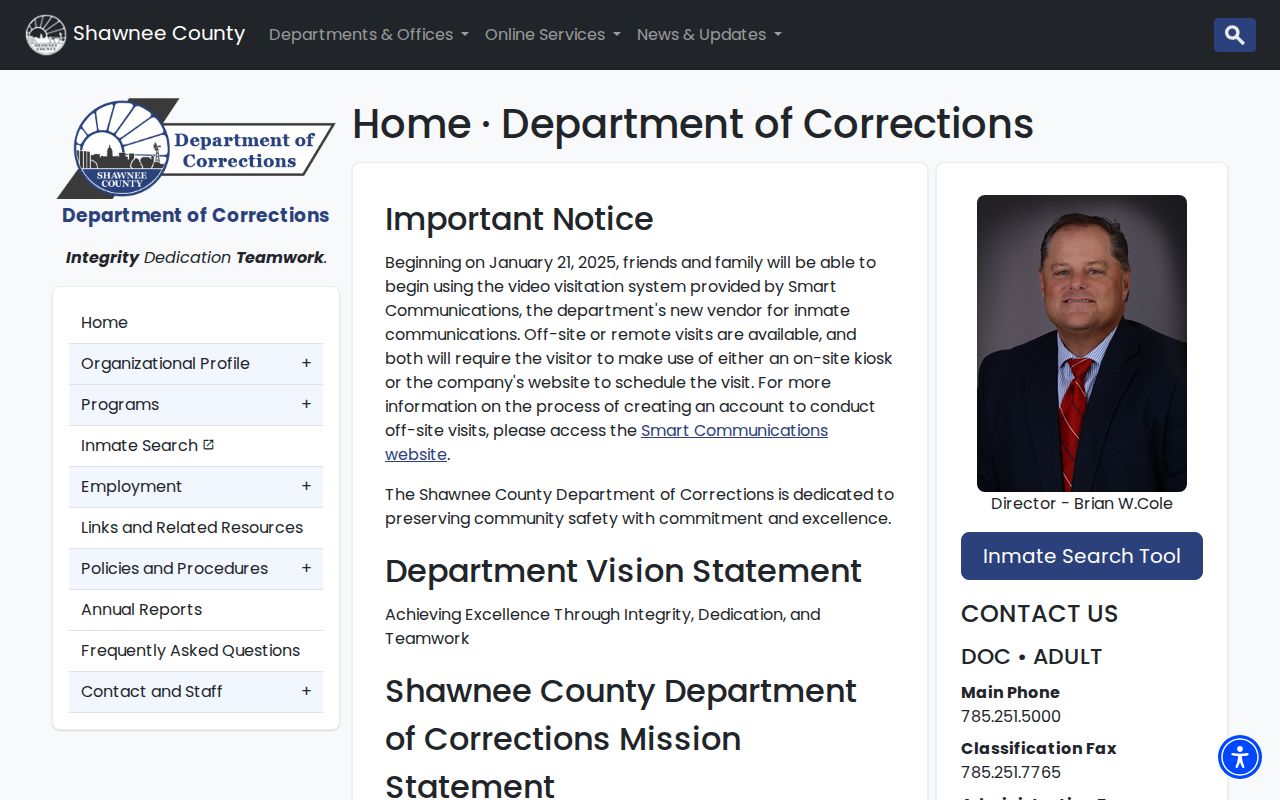
The source image reinforces a core search rule: contact Shawnee County Department of Corrections for facility facts, then use the County Clerk KORA channel for a formal county record request when needed.
Read Adult Release Records
A release record should be read as a chain of custody. “Authority” identifies who directed or permitted the person to leave. “Time” documents when the local jail episode ended. A receiving agency can show that the departure was a transfer. Bond release ends detention under the conditions in force, but it does not by itself close the criminal case. Time served or sentence completion may end the local confinement term, while probation or another form of supervision can still follow.
- Release
- The end of a specific custody episode, whether to the community or another authority.
- Transfer
- A move from this jail into another agency’s custody.
- Discharge
- The end of the legal obligation identified in the controlling record.
- Detainer
- A request or authority for another agency to take custody.
Identity matching is essential. Compare the full name, birth date, booking number, and case number across sources. A same-name result is not enough. If the formal record states a court release, the court journal entry can explain it. If it states KDOC transfer, KASPER may later show intake, movement, supervision, or discharge. If it names USMS or ICE, switch to the federal or immigration route. That disciplined handoff prevents a local no-result from becoming an unsupported conclusion.